
Did reviewers judge it too harshly and does it deserve reconsideration in 2026?
When the Anbernic RG DS launched in late 2025, it arrived to a storm of criticism. Review units shipped with a screen desynchronization bug that made gameplay feel broken, early firmware was rough around the edges, and the device’s modest Rockchip RK3568 processor couldn’t touch 3DS emulation despite Anbernic’s marketing hinting otherwise. First impressions were brutal. Retro Handhelds first look at the device summed up what many were feeling: “The RG DS is fascinating, promising, and deeply compromised.” The r/SBCGaming community piled on. Several high-profile YouTubers warned viewers to stay away. This website even chimed in in the criticism saying we were not comfortable recommending the device to anyone.
Now, several months later, does the picture look any different? Firmware updates, custom operating systems, and a growing body of real-world user experience have definitely shifted the conversation. The RG DS hasn’t become a different device, but the gap between those first impressions and what owners are saying about it is growing. In revisiting those older reviews, testing the device again, and distilling community chatter, a conclusion emerges: the RG DS was judged too harshly, and for $95, it’s a surprisingly capable little machine.
A Rocky Launch That Colored Everything
It’s worth understanding why the RG DS got such a rough reception, because the criticism wasn’t unfounded. Anbernic sent review units with a firmware build that had a serious screen-sync bug: after about 20–30 seconds of gameplay, the top screen would drop to roughly 40Hz while the bottom continued at 60Hz. For a device whose entire selling point is faithful dual-screen DS emulation, this was devastating. Reviewers rightly flagged it as a dealbreaker.
Anbernic also made the mistake of implying in its marketing that the device could handle 3DS games. The RK3568 with 3GB of RAM simply can’t do that, at least not for anything beyond the lightest titles. Buyers who came in expecting a 3DS machine were inevitably disappointed, and that disappointment colored their assessment of everything else the device could do.
And lastly, the decision to ship it with an Android version the device simply wasn’t powerful enough to handle needlessly stifled it.
The combination of buggy review units, a terrible launch, and overblown expectations created a narrative that stuck.
What the RG DS Actually Is
Strip away the expectations and the launch drama, and the RG DS is actually a pretty straightforward proposition: a sub-$100 dual-screen clamshell handheld designed primarily to play Nintendo DS games in something close to the original form factor. It also handles everything from Game Boy through PS1 comfortably, and the dual screens actually do open up for some neat multi tasking opportunities even if the experience is nowhere near that of the AYN Thor (but neither is the price).
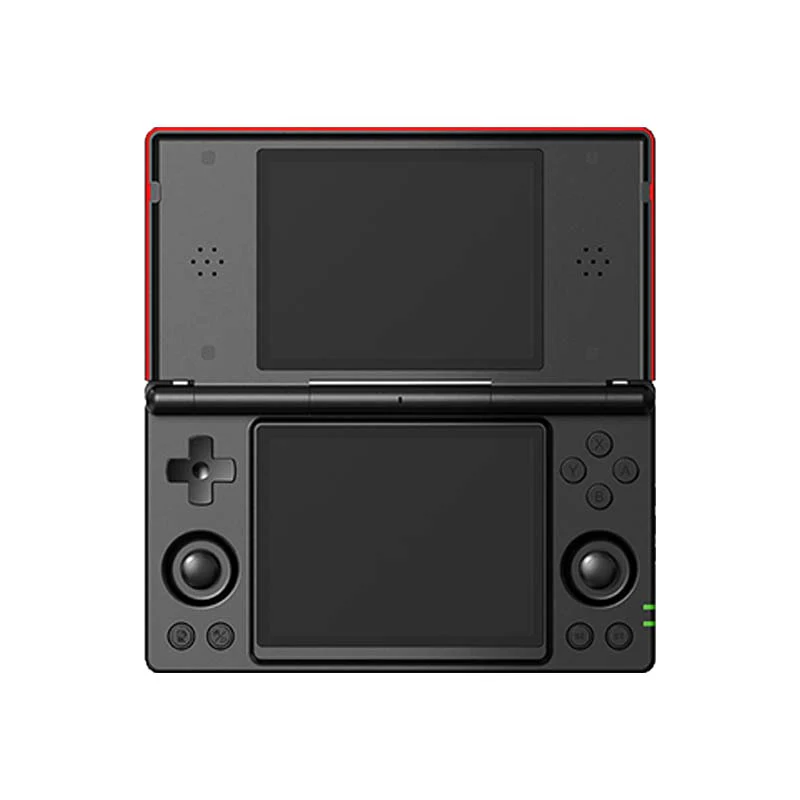
The hardware itself is solid. Multiple reviewers and community members praise the build quality, the device feels like a DSi in the hand, with a hinge that’s actually stiffer and more reliable than the original Nintendo hardware. The twin 640×480 IPS screens are bright and sharp, a noticeable upgrade over the original DS’s screens, even it doesn’t integer scale perfectly. The D-pad and face buttons are clicky and responsive, exactly what you want for platformers and RPGs. The analog sticks are admittedly poor, but they’re largely irrelevant for the DS library. The capacitive touchscreen works well for most games, though titles that demand precision stylus work (think Kirby Canvas Curse or Elite Beat Agents) suffer compared to the original’s resistive screen. The battery, rated at 4000mAh, delivers roughly 3-4 hours of DS gameplay, not great and still one of its weak points, but enough for commute-length sessions.
Crucially, it’s the only dual-screen emulation device under $100. The next option up, the AYN Thor, starts around $300. That’s not a small gap. As one Reddit user observed, it’s hard to call the RG DS overpriced when there’s literally nothing else in its price bracket that does what it does.
Saved by software?
The RG DS story is really a software story. Anbernic’s own v1.15 firmware update fixed the screen-sync issue and improved general stability. But the real transformation came from the community. Two custom firmware projects, GammaOS and Rocknix, have turned the RG DS into a noticeably better device than what shipped in the box.
GammaOS, developed by thegammasqueeze, reduces Android overhead and frees up resources for emulation. Users consistently report smoother DS performance, better upscaling stability, and quality-of-life improvements like Google services support (which enables the YouTube app on the second screen, a popular use case). Rocknix takes a different approach, replacing Android entirely with a Linux-based system optimized for emulation. Several users describe Rocknix as a “completely different experience” in terms of performance, with one noting it made the device “a lot better” compared to stock.
Anbernic’s mistake was overselling a fairly decent and good value device, that has only gotten better with custom firmware. If your goal is to play DS and below then it’s actually a good device that we now feel more comfortable with recommending.
What Owners Actually Say
When look ing at chatter online about the handheld a consistent pattern emerges. Owners who bought the device specifically for DS gaming are generally happy. People who expected more are not.
The satisfied owners tend to describe it in modest but genuinely positive terms. They’re playing through Pokémon HeartGold with fast-forward, running Castlevania and Fire Emblem collections, enjoying GBA games on one screen while watching YouTube on the other. One user carries it daily, alternating with a Vita. Another, with self-deprecating humor, describes it as perfect for playing Tetris while watching movies on his commute, adding: “I have never once been accused of having standards.” Several users explicitly mention being glad they didn’t listen to Reddit’s negativity.
The complaints that persist are real but specific. Battery life is the most common gripe, 3–4 hours doesn’t satisfy everyone and more should be expected for such a low power device. The capacitive touchscreen makes stylus-heavy games frustrating (though most DS games don’t fall into this category). The lack of RetroAchievement support through DraStic is a dealbreaker for some. And some users report hinge creakiness, though we need to wait a bit more before making concrete judgements about the hinge.
The overall sentiment has clearly shifted as firmware has matured and owners have had time to settle into using the device.
The Competition
A frequent refrain in discussions about the RG DS is “just get a Thor,” referring to the AYN Thor, a more powerful dual-screen device that handles 3DS and offers MelonDS support. It’s a fair recommendation if budget isn’t a concern, but the Thor starts at roughly $300, three times the price of the Anbernic RG DS. With accessories, shipping and duties, you could easily look at a $400 price tag. Comparing the two is a bit like telling someone shopping for a reliable commuter car that they should just buy a luxury sedan.
The MagicX Zero 40 is sometimes mentioned as a cheaper alternative at about $50. While it’s definitely a good competitor, it’s not truly dual screen and its single vertical screen layout can be awkward for games that play at standard aspect rations.
Some users suggest simply buying an original DS or DSi with an R4 card, and that’s a perfectly valid option. But an original DS can’t upscale, can’t run GBA games natively on the same device with save states, can’t stream video on a second screen, and is increasingly difficult to find in good condition. The RG DS offers something the original hardware cannot: a modern take on the DS experience with the flexibility of Android.
What the critics got right
This isn’t a defense of everything about the RG DS. The critics were right about several things. The screen-sync bug on review units was a genuine failure of quality control. Anbernic’s marketing around 3DS capability was misleading. The battery life is genuinely mediocre. The screens don’t offer perfect integer scaling for DS games (they’re 2.5x the native resolution, which means you either stretch slightly or leave small borders). The analog sticks are awkwardly placed. The included stylus is kind of janky. And the device relies heavily on DraStic, a capable but abandoned DS emulator that lacks RetroAchievement support. While not being able to run the main DS emulator MelonDS.
The problem wasn’t that reviewers identified these flaws. The problem was that the severity of the launch bugs led many to write off the entire device, and that assessment calcified into received wisdom that persisted long after the issues were addressed. When a device launches broken and gets fixed, the initial reviews live on while the fixes get buried in firmware changelogs that nobody reads.
The Verdict: Underpowered, Underpriced, and Underrated
The Anbernic RG DS is not a great device in the absolute sense. It’s underpowered, its battery life is short, and it can’t do everything its marketing once suggested. But none of that is the right frame for evaluating it.
The right frame is this: for $95, you get a well-built clamshell handheld with two bright IPS screens, solid controls, and the ability to play virtually the entire DS library in a form factor that actually feels like a DS. It handles everything from Game Boy through PS1 without breaking a sweat. With GammaOS or Rocknix installed, most DS games run at 2x resolution. You can play GBA on one screen and watch a video on the other. It fits in a bag, it’s sturdy enough to toss around, and there is literally nothing else on the market that does this at this price.
The reviewers judged the RG DS against what they wanted it to be, a budget 3DS, a Thor competitor, a do-everything machine. Measured against what it actually is, an affordable DS-focused handheld that also does older consoles well, it’s a pretty good deal. The community has come around to this view. It’s time the broader narrative caught up.
If you’re in the market for a dedicated DS emulation device and you don’t want to spend $300 on a Thor, the RG DS is worth your consideration. Install GammaOS or Rocknix, set your expectations appropriately, and you’ll likely find yourself reaching for it more often than you expected.
Got a dual screen handheld? Check out our guide for top android apps for dual screen handhelds