
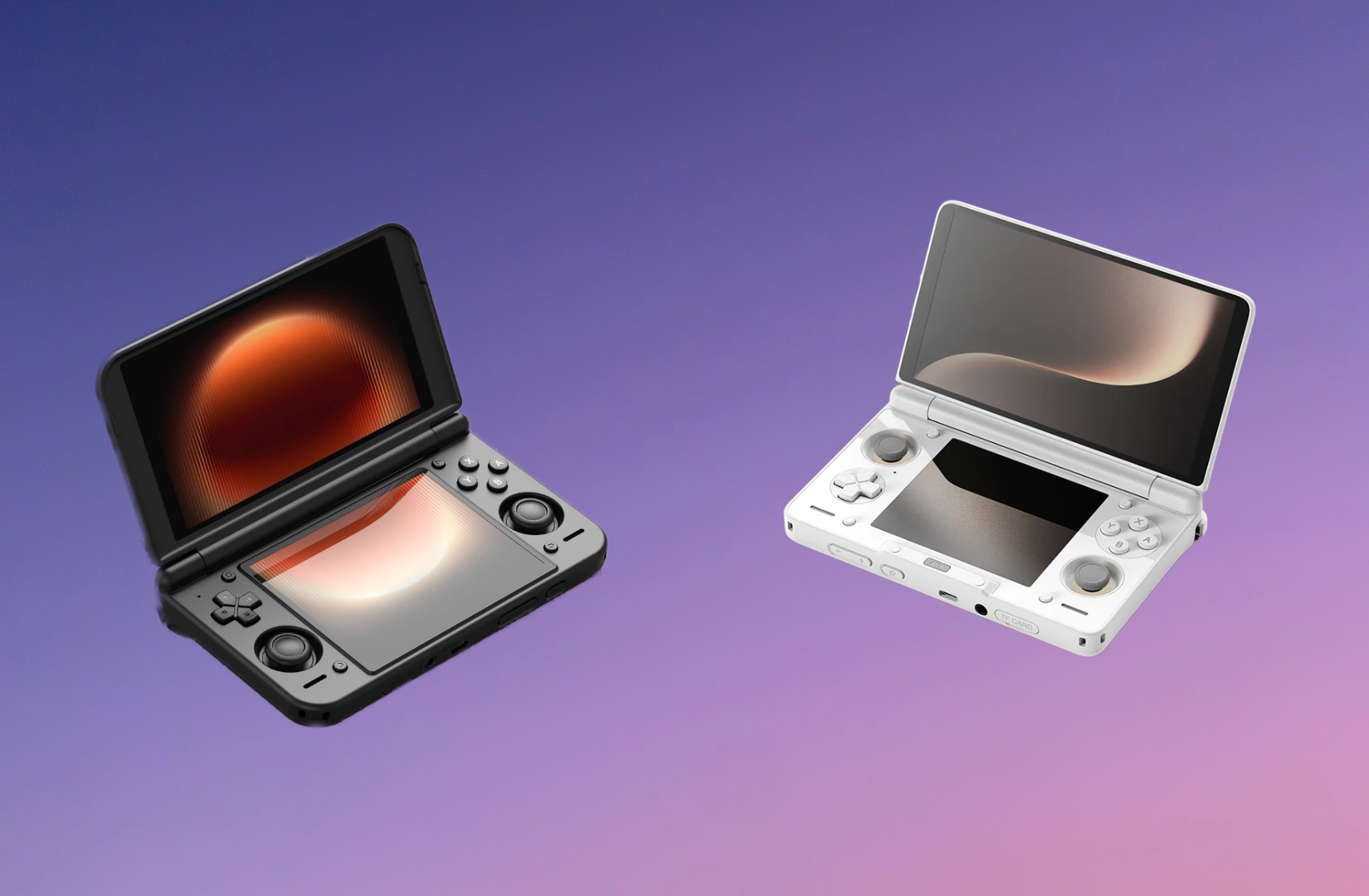
Pre-Order & Hardware Update (September 2026): Official pre-orders are now open for both the Retroid Pocket Duo and Retroid Pocket Duo Lite. Retroid has confirmed a massive 6,000mAh battery for both models, alongside finalized pricing, launch discount codes, and delivery schedules. The Duo Lite begins shipping on September 17, followed by the standard Duo in mid-October.
The dual-screen retro handheld space has moved fast over the past year, transitioning from experimental prototypes to one of the most competitive segments in portable gaming. For months, the AYN Thor stood virtually uncontested as the default recommendation for anyone wanting a dual-screen Android clamshell. That dynamic has shifted now that Retroid has opened pre-orders for the Retroid Pocket Duo lineup.
Rather than releasing a single device, Retroid surprised the community by launching two distinct models: the premium dual-OLED Retroid Pocket Duo and the budget-focused dual-LCD Retroid Pocket Duo Lite. Below is everything you need to know about specs, battery life, performance benchmarks, real-world ergonomics, and how Retroid’s new dual-screen devices stack up against the AYN Thor.
The Two Models: Retroid Pocket Duo vs. Duo Lite
Most enthusiasts anticipated a single Retroid dual-screen clamshell aimed directly at the Thor. Instead, Retroid took a dual-track approach that separates the hardware into two fundamentally different tiers, rather than merely swapping the processor.
Retroid Pocket Duo (Standard)
The flagship Retroid Pocket Duo is built around matched dual OLED displays. The primary top panel is the custom 4:3 OLED display (colloquially known in the community as the mortgage screen) first featured in the Retroid Pocket Nova, paired with a secondary OLED touch panel on the lower half. Under the hood, it runs on the Qualcomm Q-7790 chipset with an Adreno 722 GPU. Physically, the standard Duo features sculpted rear grip handles and protruding stacked shoulder triggers, providing the grip depth and travel needed for modern console controls.
Retroid Pocket Duo Lite
The Retroid Pocket Duo Lite is a completely reimagined, cost-conscious revision. To bring the entry price down to on pre-order ( retail), Retroid swapped the dual OLEDs for dual LCD displays. The chassis is trimmer and flatter than the standard model, doing away with the protruding rear grips and bulky shoulder bumps in favor of compact inline shoulder triggers. Powered by the Dragonwing QCS6125 processor with an Adreno 610 GPU, the Lite is tailored specifically as a pocketable, dedicated Nintendo DS and 16/32-bit machine.
Battery Capacity: 6,000mAh on Both Devices
One of the most significant confirmed details is that Retroid has equipped both the Pocket Duo and the Pocket Duo Lite with a 6,000mAh battery. In the dual-screen form factor, battery capacity is critical. Driving two independent display backlights and touch digitizers simultaneously creates substantially higher baseline power draw than a traditional single-screen handheld.
On the standard Pocket Duo, 6,000mAh provides the endurance required to feed the dual OLED panels and the higher-clocked Qualcomm Q-7790 chip during intensive 3DS, PS2, and GameCube sessions. On the Pocket Duo Lite, however, a 6,000mAh pack is an enormous asset. Paired with the power-sipping Dragonwing QCS6125 and dual LCDs, the Lite is positioned to deliver class-leading battery life, making it capable of extended marathon sessions in battery-hungry Nintendo DS titles without constant charging.
Specs, Architecture, and Hardware Details
The choice of silicon in the flagship Duo surprised many observers. Rather than reusing the Snapdragon 8 Gen 2 seen in the AYN Thor and the Retroid Pocket 6, Retroid selected the Qualcomm Q-7790. This chip is an IoT (Internet of Things) variant of the Snapdragon 7 Gen 4 architecture. Stripping out cellular baseband modems that handhelds never use allows the chip to run cool and dedicate its entire thermal envelope to sustained compute and graphics throughput.
Storage and memory configurations reflect the current DRAM market. The Pocket Duo Lite offers accessible configurations starting at 64GB (expandable via microSD), with an optional 128GB tier for users building extensive ROM libraries. The standard Pocket Duo comes standard with 128GB of high-speed internal storage, ensuring plenty of headroom for modern Android 13/14 overhead and dual-screen application caching.
Synthetic Benchmarks & SoC Comparison
| Chipset | Qualcomm Q-7790 | Dragonwing QCS6125 (% vs. Q-7790) | Snapdragon 865 (% vs. Q-7790) | Snapdragon 8 Gen 2 (% vs. Q-7790) |
| CPU Score | 48 | 15 (-68.8%) | 40 (-16.7%) | 64 (+33.3%) |
| GPU Score | 25 | 3 (-88.0%) | 17 (-32.0%) | 43 (+72.0%) |
| Energy Efficiency | 91 | 77 (-15.4%) | 86 (-5.5%) | 91 |
| Target Devices | Retroid Pocket Duo | Retroid Pocket Duo Lite | Retroid Pocket 5, AYN Thor Lite | Retroid Pocket 6, AYN Thor, AYN Odin 2 |
The benchmark data gives us an objective look at where each device fits in the wider market:
- Retroid Pocket Duo (Qualcomm Q-7790): Outperforms older Snapdragon 865 flagships in single-core and multi-core CPU efficiency, while trailing the Snapdragon 8 Gen 2 in raw 3D GPU muscle. It delivers ample headroom for full-speed 3DS upscaling, comprehensive PS2 and GameCube playback, and lighter Switch titles.
- Retroid Pocket Duo Lite (Dragonwing QCS6125): Offers modest graphics horsepower compared to mid-range chips, but comfortably handles the entire Nintendo DS catalog at native speeds, alongside GBA, SNES, Genesis, PS1, and N64.
- AYN Thor (Snapdragon 8 Gen 2): Remains the undisputed raw performance leader in the clamshell category. If your priority is heavier Switch emulation, high-end PC game translation, or 4x upscaled PS2 rendering, the Thor continues to offer the highest graphical ceiling.
Graphics Drivers and Turnip Support
A primary question among emulation enthusiasts has been whether the unusual Qualcomm Q-7790 would suffer from immature graphics drivers. Fortunately, the chip incorporates an Adreno 722 GPU, an architecture fully supported by community Turnip Mesa drivers from day one. This guarantees access to custom Vulkan driver configurations in Citra, Lime3DS, and Yuzu forks, avoiding graphical glitches in complex 3D titles.
On the Duo Lite, the Adreno 610 GPU relies on Qualcomm’s long-established mainline driver stack. Because the Lite targets 2D systems, 32-bit consoles, and Nintendo DS emulation via Drastic and MelonDS, experimental driver translation is not required for smooth gameplay.
Real-World Gameplay Showcases
Retroid has published official gameplay showcase footage demonstrating 3DS titles running on both hardware variants. Keep in mind that these videos represent early engineering units, but they give a solid impression of display scaling and audio-visual synchronization.
Retroid Pocket Duo Gameplay
Retroid Pocket Duo Lite Gameplay
Hardware Comparison: Duo vs. Duo Lite vs. AYN Thor
| Feature | Retroid Pocket Duo Lite | Retroid Pocket Duo | AYN Thor (Base) |
|---|---|---|---|
| Top Display | 4:3 LCD | 4:3 OLED (Custom) | 16:9 AMOLED |
| Bottom Display | Touch LCD | Touch OLED | Touch AMOLED (3.92″) |
| Processor (SoC) | Dragonwing QCS6125 | Qualcomm Q-7790 | Snapdragon 8 Gen 2 |
| GPU | Adreno 610 | Adreno 722 | Adreno 740 |
| Battery | 6,000mAh | 6,000mAh | 6,000mAh |
| Triggers | Inline triggers (Flat) | Stacked analog triggers | Stacked analog triggers |
| Primary Target | Nintendo DS, GBA, PS1, N64 | 3DS, PS2, GameCube, Retro | High-end 3DS, Switch, PS2 |
| Pre-Order Price | (Code: DUOLITE) | (Code: DUO) | N/A (Retail only) |
| Retail MSRP | (64GB) / (128GB) | + | |
| Shipping Date | September 17, 2026 | Mid-October 2026 | Shipping now |
Pre-Orders, Pricing, and Shipping Schedules
Pre-orders for both Retroid models are currently live on the official storefront, with introductory coupon codes active during the pre-launch window:
- Retroid Pocket Duo Lite: Priced at during pre-orders using coupon code DUOLITE ( MSRP after launch for 64GB, and for 128GB). Shipping commences on September 17, 2026.
- Retroid Pocket Duo: Priced at during pre-orders using coupon code DUO ( MSRP after launch). Units begin shipping in mid-October 2026.
- AYN Thor: The entry-level Thor Lite (, SD865) has faced persistent stock shortages, leaving the Thor Base () as the practical baseline option. While the Thor Base is actively shipping, it commands a significant price premium over both Retroid devices.
Which Dual-Screen Handheld Should You Buy?
Retroid’s pricing strategy makes the buying decision straightforward based on your emulation priorities and budget:
- Buy the Retroid Pocket Duo Lite if you want an affordable, highly pocketable clamshell dedicated to Nintendo DS and retro 16/32-bit gaming. At on pre-order with a massive 6,000mAh battery and inline triggers, it offers unmatched value in the dual-screen space with zero direct competition under .
- Buy the Retroid Pocket Duo if you want the premium visual experience of dual OLED panels, ergonomic rear grips with stacked triggers, and enough processing power to run 3DS upscaled, GameCube, and PS2 without spending over .
- Buy the AYN Thor if you need peak Snapdragon 8 Gen 2 performance for demanding Switch titles and high-end emulation, and you are comfortable paying or more for immediate hardware availability.
Dual-Screen Handheld Guides and Resources
- Every Dual-Screen Retro Handheld Ranked (2026)
- The Best Android Apps for the AYN Thor & Dual-Screen Handhelds
- Retro Handheld Performance Tier List: Most Powerful Ranked
- Retro Handheld Deal Tracker

Get alerts for
We'll email you when this product drops in price or comes back in stock.
You're signed up!
Error. Try again.

Retroid Pocket Duo Lite Handheld
| 64GB | $149.00 | ● |
| 128GB | $169.00 | ● |
| Lite 4+64 | $149.00 | ● |
| Lite 6+128 | $169.00 | ● |
| Plus 8+128 | $219.00 | ● |

AYN Thor
| 128GB | $259.00 | ● |
| 256GB | $409.00 | ● |
| Max 16+1TB | $579.00 | ● |
| 512GB | $479.00 | ● |
AYN Thor
| 128GB | $259.00 | ● |
| 256GB | $409.00 | ● |
| Max 16+1TB | $579.00 | ● |
| 512GB | $479.00 | ● |