
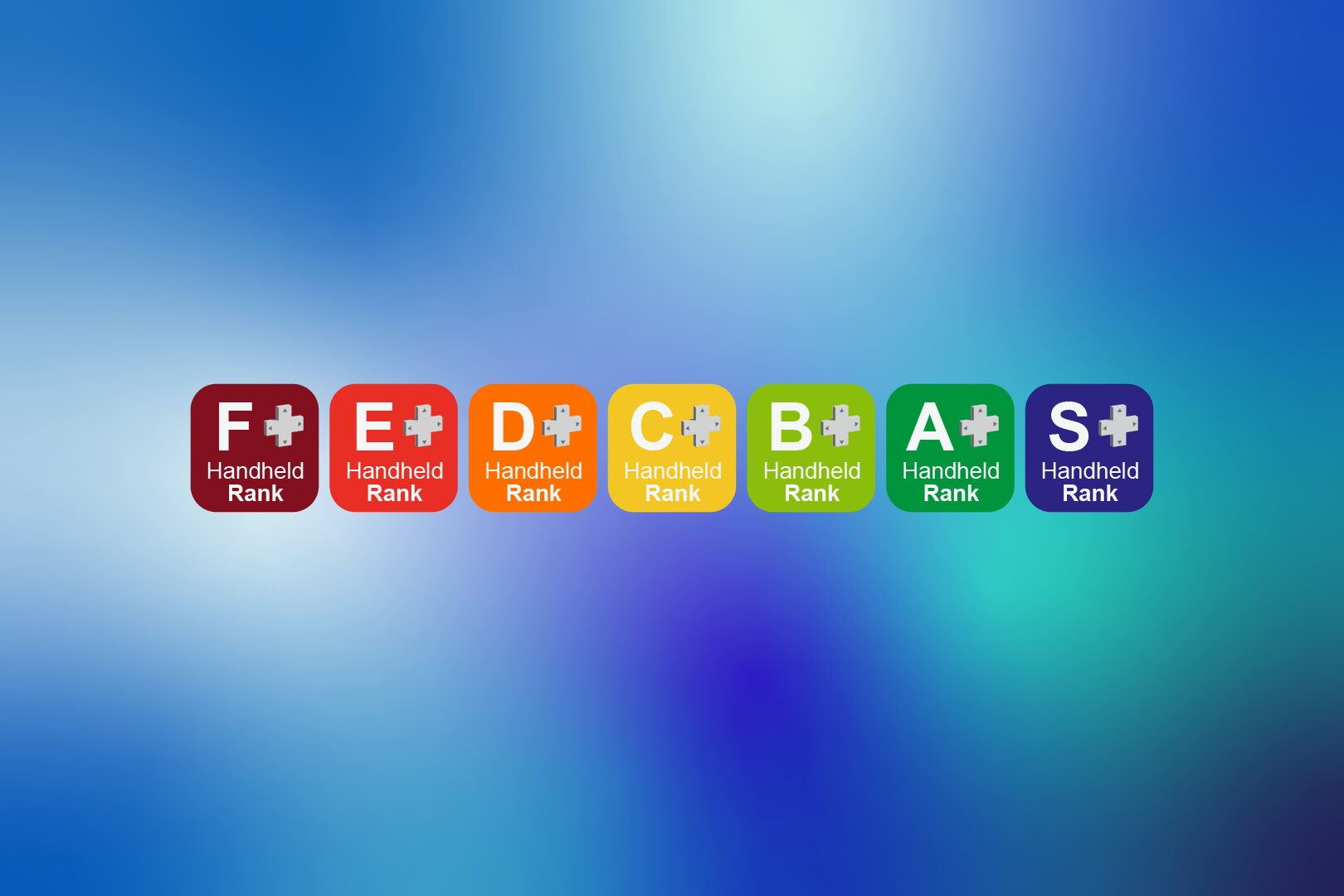
From NES to PC and Switch emulation find the device that suits your needs
With so many retro handhelds available it’s hard to keep track of which device actually suits your needs. A key factor in that is performance, and most importantly having enough of it to play the games you’re looking to play. Many factors go into real word game performance, such as driver support, specific chipset quirks, and heat management. HandheldRank has attempted to create the first comprehensive performance index specifically targeted at the needs of retro handhelds.
| Device | Handheld Performance Score | Performance tier |
|---|---|---|
| Anbernic RG DS | 77 | F |
| MANGMI AIR X | 107 | E |
| MagicX One 35 | 133 | E |
| Anbernic RG505 | 140 | E |
| Anbernic RG405M/RG405V | 145 | E |
| Anbernic RGCUBE | 253 | D |
| Anbernic RG556 | 256 | D |
| Anbernic RG406V/RG406H | 256 | D |
| Anbernic RG Slide | 259 | D |
| Anbernic RG 476H | 262 | D |
| Retroid Pocket 4 Pro | 344 | C |
| Retroid Pocket Flip2 (D1100) | 348 | C |
| MANGMI Pocket Max | 355 | C |
| Retroid Pocket Flip 2 | 361 | C |
| Retroid Pocket 5 | 361 | C |
| Anbernic RG557 | 441 | B |
| Anbernic RG 477V/RG477M | 444 | B |
| Retroid Pocket G2 | 541 | A |
| AYANEO Pocket EVO | 550 | A |
| AYANEO Pocket DMG | 551 | A |
| AYANEO Pocket DS | 560 | A |
| AYANEO Pocket S | 564 | A |
| AYANEO Pocket ACE | 570 | A |
| AYN Thor | 584 | B |
| Retroid Pocket 6 | 602 | B |
| AYN Odin 2 Portal | 610 | B |
| ONEXSUGAR SUGAR 1 | 661 | A |
| AYANEO Pocket FIT | 686 | A |
| AYANEO Pocket S2 Pro | 687 | A |
| AYN Odin 3 | 888 | S |
F-tier handhelds:
30. Anbernic RG DS – Performance score: 77
Pointing out that the Anbernic RG DS is underpowered feels at this point to be like beating a dead horse. However we were still surprised just how underpowered it was compared to other current retro handheld offerings. Which is a shame, because we actually do want to like the RG DS. But unless you really want to specifically emulate the DS on dual screens we can’t recommend this device to anyone in good conscience.
Chipsets in this tier
Rockchip RK3568
F-tier can play these systems:
Yes, with enhancements:
DS, SNES, GBA
Probably, with native resolution:
PS1, N64
Maybe, with tinkering:
Dreamcast, PSP
Best deal of F-tier: None.
E-tier handhelds: Around $100
29. MANGMI AIR X – Performance score: 107
28. MagicX One 35 – Performance score: 133
27. Anbernic RG 505 – Performance score: 140
26. Anbernic RG 405V/RG 405M – Performance score: 148
While their performance is nothing to write home about these devices do serve a very specific role. They’re the entry level budget devices. With these you should expect to be able to emulate any classic retro system like the SNES or GBA with ease, as well as play early 3D games mostly well and with enhancements such as upscaling. Even some GameCube and PS2 titles should be playable, especially with hacks and downscaling, though this will only be true for a handful of games. Another use for devices such as these could be as a dedicated game streaming device for services like Moonlight, GeForce Now, XCloud, or PSLink.
Chipsets in this tier
Snapdragon 662, Tiger T618
E-tier can play these systems:
Yes, with enhancements:
DS, N64, PS1, PSP
Probably, with native resolution:
Dreamcast, 3DS
Maybe, with tinkering:
Saturn, PS2, GameCube
Best deal in E-tier: While not the most powerful in this tier, the whole package of the MANGMI AIR X, with it’s 1080p screen, 5000mah battery, and good build quality makes it into one of the best value budget handhelds currently on offer.
D-tier handhelds: Entry level PS2 and GameCube around $150
25. Anbernic RG CUBE– Performance score: 253
24. Anbernic RG 556– Performance score: 256
23. Anbernic RG 406H/RG 406V– Performance score: 257
22. Anbernic RG Slide – Performance score: 259
21. Anbernic RG 476H – Performance score: 262
This is the tier when PS2 and GameCube emulation actually starts becoming feasible. Most GameCube games should be upscalable to 2x resolution, and most PS2 and Wii games should be playable at full speed at at least native resolution. Which doesn’t sound too impressive compared to higher ranked entries, but when you factor in the price of many of these devices it starts making sense. Some Switch and Wii U emulation might even be possible on these devices, though that will be limited to very lightweight, mostly 2D, titles.
Chipsets in this tier
Tiger T820
D-tier can play these systems:
Yes, with enhancements:
N64, PS1, PSP, Dreamcast, DS, 3DS, GameCube
Probably, with native resolution:
Saturn, PS2, Wii
Maybe, with tinkering:
Wii U, Switch
Best deal of D-tier: It’s hard to pick as they’re all powered by the same chipset and roughly priced the same. But in the end we feel like the RG476H will probably be the best option for most people. For the systems the T820 is able to play the 4:3 screen makes the most sense, and with the RG476H it’s even 120Hz. Which is fantastic for older games as it allows for “black frame insertion”.
C-tier handhelds: Around $200
20. Retroid Pocket 4 Pro – Performance score: 344
19. Retroid Pocket Flip 2 (D1100) – Performance score: 348
18. MANGMI Pocket Max – Performance score: 355
17. Retroid Pocket Flip 2 (SD865) – Performance score: 361
16. Retroid Pocket 5 – Performance score: 440
15. Anbernic RG 557 – Performance score: 441
14. Anbernic RG 477V/RG 477M – Performance score: 444
For some this tier hits a real performance sweet spot. Almost any PS2 and GameCube game should be playable with ease, and likely upscaled too at that. Depending on driver support modern android gaming should be very doable, and as icing on the cake Switch and PC emulation starts looking pretty feasible. You won’t necessarily be playing the heavy hitters, but a surprising amount of PC and Switch games will run smoothly. Especially on the SD865 devices with better driver support.
Chipsets in this tier
Dimensity 1100, Snapdragon 865, Dimensity 8300
C-tier can play these systems:
Yes, with enhancements:
PS2, GameCube
Probably, with native resolution:
Lightweight Switch and PC
Maybe, with tinkering:
Heavier Switch titles
Best deal of C-tier: The Retroid Pocket 5. While it’s a difficult choice between the SD865 devices, as they largely serve different purposes. The Retroid Pocket 5 comes out as a winner due to simply being a great all arounder and lacking any glaring flaws.
B-tier handhelds: $200+
13. Retroid Pocket G2 – Performance score: 541
12. AYANEO Pocket EVO – Performance score: 550
11. AYANEO Pocket DMG – Performance score: 551
10. AYANEO Pocket DS – Performance score: 560
9. AYANEO Pocket S – Performance score: 564
8. AYANEO Pocket ACE – Performance score: 570
7. AYN Thor (SD 8 Gen 2) – Performance score: 584
6. Retroid Pocket 6 – Performance score: 602
5. AYN Odin 2 Portal – Performance score: 610
Bio: In early 2026 the B-tier should be the current baseline for flagship retro handheld performance. With devices performing above this baseline still feeling like premium devices for hardcore enthusiasts, and those below it like the underpowered yet (hopefully) budget friendly options. This tier should handle virtually any system with decently mature emulators available for android with ease. At most a few Switch titles could benefit from having more than 8GBs of RAM. This level of performance should also allow for some pretty extensive ventures into PC emulation through Gamehub or GameNative.
Chipsets in this tier
Snapdragon G2 Gen 2, Snapdragon G3x Gen 2, Snapdragon 8 Gen 2
B-tier can play these systems:
Yes, with enhancements:
Lighter Switch
Probably, with native resolution:
Heavier Switch, lighter PC
Maybe, with tinkering:
Heavier PC, lighter PS3
Best deal of B-tier: While there is something to be said for almost all devices in this tier the Retroid Pocket 6 ends up being the best deal of them all. In fact we’re willing to go as far as claiming it’s currently the best deal on the market. For $229 you’re getting a lot of device for your money. Want to know more about the Retroid Pocket 6?
A-tier handhelds:
4. ONEXSUGAR SUGAR 1 – Performance score: 661
3. KONKR Pocket FIT – Performance score: 686
2. AYANEO Pocket S2 Pro – Performance score: 687
This tier is where the devices enter real hobbyist territory. Most users won’t need the extra power afforded by the top tier G3 Gen 3 chip that powers these devices. For now the emulators that really make use of all that extra power simply aren’t mature enough to offer the same plug and play experience as emulators for say the GameCube or PS1. However if you’re looking for something that could be a serious PC gaming device, or to explore emulation frontiers such as the PS3 then this tier is where you should start looking.
Chipsets in this tier
Snapdragon G3 Gen 3
A-tier can play these systems:
Yes, with enhancements:
Switch
Probably, with native resolution:
PS3, PC
Maybe, with tinkering:
Heavier PC
Best deal: When the KONKR Pocket FIT launched it briefly held the title as the most powerful retro handheld on the market. Which just becomes all the more impressive considering the sub-$300 price tag. In fact it’s such a good deal that one of its main drawbacks is the high demand leading to limited availability.
S-tier handhelds:
1. AYN Odin 3 – Performance score: 888
Bio: As of right now the AYN Odin 3 is the most powerful retro handheld you can get, and by a pretty hefty margin too. While the chipset that powers it, the Snapdragon 8 Elite, has struggled with drivers in the past. Recent breakthroughs has started unlocking the massive power of the Odin 3. It’s powerful to the point where the only current use of such performance seems to be to play modern AAA PC titles, or perhaps to future proof while waiting for exciting prospects such as mature PS3, Xbox 360 or perhaps one day even PS4 emulation on android (though please don’t expect that anytime soon).
Chipsets in this tier:
Snapdragon 8 Elite
S-tier can play these systems:
Yes, with enhancements:
Pretty much everything
Probably, with native resolution:
PS3, PC
Maybe, with tinkering:
The absolute latest AAAs?
Best deal of S-tier: As the sole occupant of this tier the AYN Odin 3 wins by default. However that should not detract from what an amazing piece of hardware this is, and that at $329 for the base model it’s not even all that pricy considering it’s the strongest retro handheld you can currently get.